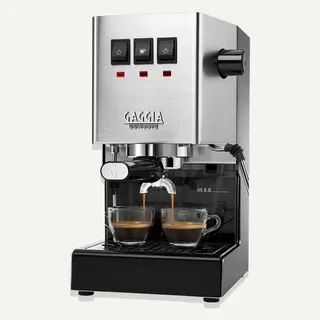
Gaggia Classic Pro Review
One espresso machine, $549. The Gaggia Classic Pro is a single boiler espresso machine with a 58 mm portafilter and no PID, sold in the US as the Classic Evo Pro, with a brass-boiler version, the E24, on US shelves too. Without a PID, timing does the work: one reviewer's puck readings ranged from 202°F to 216°F depending on when the shot started. On Amazon, 61 of 65 mentions of leaks are complaints. It suits beginners who want to learn, and later mod, a simple machine.
 By Kirill Gissa · Published · Prices checked October 16, 2026
Gaggia Classic Evo Pro at a glance
Similar models with a store link
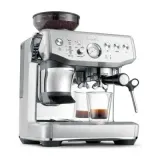
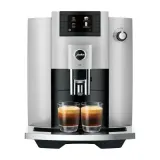
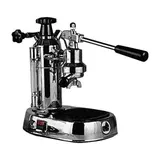
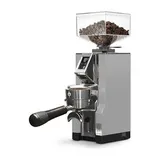
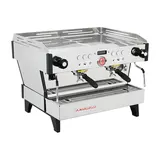
There's no store link for any Gaggia model. The closest ones that have one, matched on type, size and price:
Who it suits
someone who wants to learn espresso on a simple, repairable machine with a commercial-size 58 mm portafilter, and doesn't mind a routine of flushing and timing shots to the light.
you want the temperature handled for you; the Breville Bambino Plus has PID control at $499.95. Skip it too if you plan to mod it under warranty: Gaggia's US warranty excludes “units that have been modified.”
Specs and claimed vs measured
Gaggia publishes almost no performance figures for the Classic, and its US importer's site blocked our checks, so the left column is thin. The reviewer column comes from four video reviews, almost all of the E24; Coffee Kev ran the E24 and the Evo Pro side by side. Whole Latte Love sells the machine.
| Gaggia says | Reviewers recorded | |
|---|---|---|
| Warm-up | Not stated | ready light “just over a minute” from cold (Coffee Kev); boiler stable after about 12 min (Espresso Hackers, on a unit modified for measurement); 10 min recommended (Whole Latte Love, a retailer) |
| Temperature in the coffee | Not stated | 200°F with about 2°F of variance over a 30-second shot (Whole Latte Love); 207°F (97.2°C) at the puck, starting as the light went off (Espresso Hackers, on a unit modified for measurement) |
| Brew pressure | 9-bar OPV spring on the Evo Pro (Stark Insider) | about 9 bar on a test device (Whole Latte Love) |
| Steam ready after switching | Not stated | about 60 s (Whole Latte Love); about 65 s on the E24, 50 s on the Evo Pro (Coffee Kev) |
| Steaming | Not stated | 5 fl oz of milk from 42°F to 142°F in 24 s (Whole Latte Love); 11.8 fl oz (350 ml) to 140°F in 62 s on the E24, 74 s on the Evo Pro (Coffee Kev) |
Warm-up has two answers. The ready light comes on in about a minute, but Espresso Hackers logged the boiler cycling steadily only after 12 minutes, on a unit modified for measurement, and Whole Latte Love waits 10 minutes with the portafilter locked in.
Once warm, the E24 can hold a steady shot. Whole Latte Love's thermocouple read 200°F in the coffee with about 2°F of variance, and its test device went from 203°F at 10 seconds to 198°F at 28. The catch is the start, which the next section shows.
Real price: MSRP, street price, tax and shipping
Gaggia North America's store lists the Gaggia Classic Pro E24 at $549, and the lowest dealer price we found was $499 (checked October 16, 2026). Sales tax applies on top and varies by state.
The machine is only part of the cost. There's no grinder, and an espresso grinder is not optional here; see our espresso grinder picks. Gaggia's manual also calls for its own descaling solution every two months.
Where to buy: importer, dealers and Amazon
In the US, Gaggia machines come through an importer, IMPORTIKA INC. of Rochester, NY, which uses the “Evo Pro” name. Gaggia's global catalog lists the Classic E24, GT, and UP instead. Dealers list four colors of the RI9380: brushed stainless, polar white, thunder black, and lobster red.
Gaggia's warranty needs dated proof of purchase. It excludes machines used commercially or taken out of the country where they were bought, so buy from a US seller and keep the receipt. Amazon's listing we track is for the E24 and showed it as currently unavailable on October 15, 2026.
Financing
We found no financing offer we could confirm on the importer's or dealers' pages. If you pay over time, get the plan's APR and term on screen at checkout.
Warranty and returns
Gaggia's US terms are in its warranty booklet: “Your Gaggia is covered under warranty for 12 months from the date of original purchase.” It adds that “Gaggia will pay all labor costs incurred within first 12 months,” and that you call 1-888-389-4123 for a return authorization number before sending anything.
Two exclusions matter on this machine. One is mods: the warranty doesn't cover “finishes or damage resulting from accident, misuse, abuse, tampering, or units that have been modified, used for commercial purposes, or removed from the country in which they were purchased.”
The other is wear: it excludes “issues caused by scale build up, parts or normal-wear items such as gaskets, portafilter handles, filter baskets, pannarello wands.” Owners often add a PID or swap the pressure spring, so do it after the first year, not during it. We couldn't read the importer's return policy, so check the seller's before you buy.
Parts and service in the US
Warranty service is by mail through the importer, after you get the authorization number. The manual says, “For service or support, contact your local dealer or an authorized service center” (p. 12). The importer's parts store was unreachable when we checked.
The Classic's appeal is that it's simple to keep going: the group gasket, baskets, and portafilter are standard 58 mm parts, which our portafilter size chart covers. Those are also the wear parts the warranty excludes. Our espresso machine brand guide compares Gaggia's service and warranty with other brands.
Boiler and temperature control
The Classic has one boiler and a thermostat instead of a PID. The brew thermostat on the E24 is a stock 225°F (107°C) part, per Espresso Hackers' correction video. Without a PID, the water temperature rises and falls in a cycle, and the shot temperature depends on where in that cycle you start.
| Shot started | Start | Lowest | Drop |
|---|---|---|---|
| As the brew light goes off | 207°F | 205°F | 3°F |
| As the brew light comes on | 210°F | 203°F | 7°F |
| At the boiler peak | 216°F | 210°F | 6°F |
| After a short warm-up, no flush | 202°F | 197°F | 4°F |
That table is the case for “temperature surfing”: flush, wait for the light, then start at a set point in the cycle. Starting as the light went off gave the most stable shot, a 3°F drop over the shot. Starting after a short warm-up with no flush gave the coolest.
Classic Pro vs Evo Pro vs E24: what changed
The 2023 Evo Pro is Gaggia North America's update of the Classic Pro on the same RI9380 platform. Per Stark Insider (June 22, 2023), it ships with a 9-bar pressure spring, a polished stainless 58 mm portafilter, and an anti-scale boiler coating. The E24 uses a brass boiler instead of coated aluminum.
The measured differences favor the E24. Coffee Kev found water leaving its group about 5°F hotter than the Evo Pro's after 5 and 10 minutes, and it steamed faster (see below). In Espresso Hackers' cold-water bench test, the brass boiler came out 10°F hotter than aluminum (video). The Gizmo Garage also refers to an issue with the earlier coated-aluminum boiler.
Gaggia's global lineup also has a Classic GT and a Classic UP. We haven't added them to our database, so we don't compare them here.
Pump and pressure
The pump is a vibratory type. The Evo Pro's 9-bar spring limits brew pressure from the factory, and Whole Latte Love's test device read about 9 bar during a shot on the E24. On r/espresso, long-term owners of older units describe fitting a 9-bar spring themselves; the warranty excludes modified machines.
Steam wand and milk
With one boiler, steaming means flipping the steam switch and waiting for the boiler to heat further. Whole Latte Love waited about 60 seconds for the steam light. It then took 5 fl oz of milk from 42°F to 142°F in 24 seconds.
Coffee Kev's side-by-side shows the same gap: 5.7 fl oz (170 ml) of milk reached 140°F in 30 seconds on the E24 and 33 on the Evo Pro; 11.8 fl oz took 62 against 74.
Daily upkeep: cleaning, descaling and water
Gaggia's manual (2019 edition) says “Descaling should be performed every 2 months” using Gaggia's descaling solution (p. 18). That matters for the warranty, which excludes damage from scale buildup. The manual doesn't describe backflushing or a water filter.
The group gasket is a wear part; one Amazon owner reports replacing it once in three years of daily use. Our espresso machines under $500 list covers what else sits at this level.
Recalls and safety notices
The CPSC recall database had no entry for Gaggia under any espresso or coffee search as of October 15, 2026. We found no UL or ETL listing record; the manual says only that the machine complies with applicable standards.
What owners say
The Amazon listing we track, for the E24, shows 4.3 out of 5 from 3,200 ratings and sorts reviews by topic (checked October 15, 2026). On Reddit we read 682 posts and comments from October 26, 2024 to October 14, 2026; that's one site, so it doesn't make a complaint index.
What owners complain about
Leaks are the most one-sided topic on Amazon: 61 of 65 mentions are complaints. Durability draws the most complaints by count, 82 of 130, and one Amazon owner wrote, “Great coffee for a year. Broke 1 month after warranty expired.” Shot consistency follows, 47 of 65, which fits the temperature cycle above.
On Reddit, one owner of a 2023 unit wrote “Good deal I thought until the group head started leaking on the second shot.” (r/espresso, October 13, 2026). Reddit's complaint rate was low overall: one of 682 posts described a breakdown.
What owners praise
Espresso quality gets the most praise: 190 of 214 Amazon mentions are positive, and overall performance 364 of 430. Long-term owners on r/espresso report years of use; one wrote “I thought maybe I’d be dissatisfied with mine, 5 years on and I’m still more than happy with it, paired with a timemore 078s.” (r/espresso, July 18, 2026).
The Gizmo Garage reported no failures after 7 months.
Questions people ask
Is the Gaggia Classic Pro worth it?
It is if you want to learn the manual side of espresso and may mod the machine later. You get a 58 mm portafilter and a simple single boiler with no PID, so shot temperature depends on your timing. Owners rate the espresso well, but leaks and durability draw the most Amazon complaints, and the warranty is one year.
Which Gaggia Classic should I avoid?
We don't tell you to avoid one; we can show where they differ. In Coffee Kev's side-by-side, the brass-boiler E24 steamed 11.8 fl oz of milk in 62 seconds against 74 for the coated-aluminum Evo Pro. It also ran about 5°F hotter at the group. One reviewer also refers to an issue with the earlier coated-aluminum boiler.
What's the difference between the Classic Pro and the E24?
The E24 uses a brass boiler; the Classic Pro and its 2023 Evo Pro update use coated aluminum. Reviewers measured the E24 steaming faster and running a little hotter. Both share the RI9380 platform, the 58 mm portafilter, and the single-boiler, no-PID design.
How long will a Gaggia Classic last?
Owners on r/espresso report five and six years of daily use, often with a PID or spring mod added. On Amazon, though, 82 of 130 mentions of durability are complaints, and the warranty covers only one year. Gaskets and baskets wear out and aren't covered, so plan on replacing them.
Is Gaggia or De'Longhi better?
They suit different buyers. The Gaggia Classic is a manual single boiler: you grind, tamp, and time each shot. De'Longhi's Magnifica Evo is a super-automatic at $899.95 that grinds and brews at a button press, with a longer warranty. Pick the Gaggia to learn espresso; pick the De'Longhi to skip that step.